
The rough patch of democracy, Acemoglu says: “Emocracies are going through a rough patch,” he added
“Democracies are going through a rough patch,” Acemoglu said. “And it is in some sense quite crucial that they reclaim the high ground of better governance, cleaner governance, and delivering sort of the promise of democracy to a broad range of people.”
While autocratic governments can boost growth temporarily by pouring resources into favored industries, that is hard to sustain. He acknowledged democracies don’t always deliver on their potential for widespread prosperity. Survey data shows support for democracy is at an all time low.
China has lifted hundreds of million of people out of poverty despite its autocratic governing structure.
“Introducing democracy is hard, it’s very hard,” he said. “When you introduce elections, that sometimes creates conflict. In societies with too much division, elections can result in short-lived outcomes that are not democratic.
“When Europeans colonised large parts of the world, the existing institutions sometimes changed dramatically, but not in the same way everywhere. In some colonies they used natural resources to benefit the colonizers. In other cases, the colonisers built inclusive political and economic systems.”
Daron Acemoglu and James A. Johnson: The history of European colonialism and the origins of the inequality in women’s economic opportunities
By coincidence, the announcement came on a U.S. holiday that honors both European explorer Christopher Columbus and the indigenous people of the new world.
“Rather than asking whether colonialism is good or bad, we note that different colonial strategies have led to different institutional patterns that have persisted over time,” Acemoglu said during a news conference in Stockholm where the prize was announced.
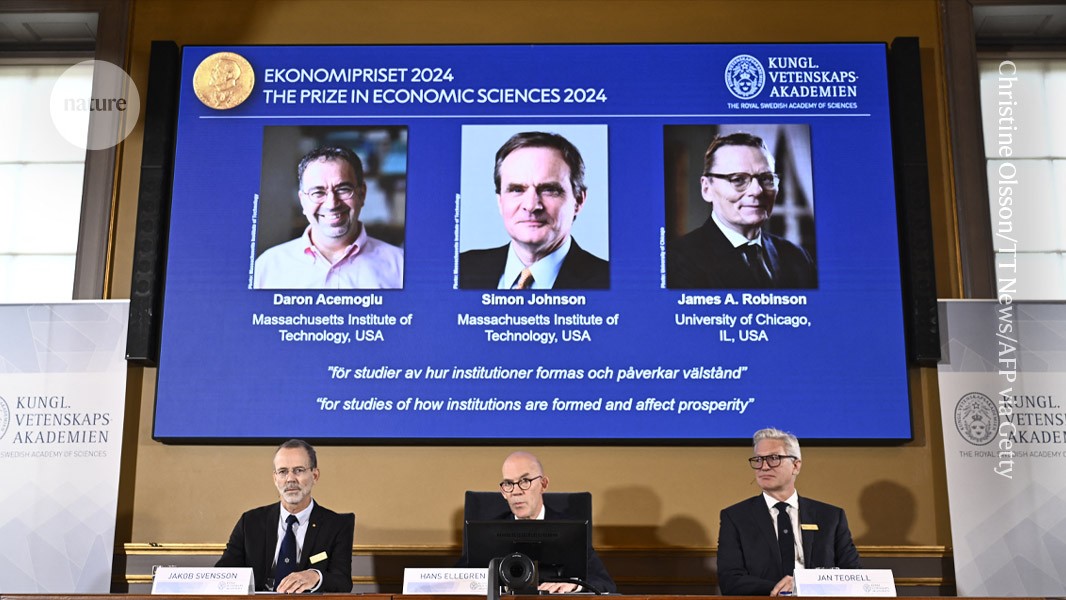
Three men received the economics prize for tracing the roots of national prosperity in the former European colonies by studying vastly different outcomes.
The discipline of economics has focused on the wealth and poverty of nations for 250 years, since Adam Smith founded it.
The income gap between the richest and the poorest nations has been widely documented. However, Daron Acemoglu and Simon Johnson, both from the Massachusetts Institute of Technology in Cambridge, and James A. Robinson from the University of Chicago in Illinois, have studied the evidence for why these inequalities persist.
A University of Cambridge researcher says they looked at the history of European colonialism and the contrast between the fortunes of countries such as the United States or Australia. “Their work has had a profound impact on how people think about economic development.”
The Royal Swedish Academy of Sciences said in a statement that the Laureates demonstrated that the places where the richest at their time of colonization were now among the most impoverished.
“It looks as if long-standing inequalities in women’s opportunities are still being reflected in the distribution of the Nobel prizes,” says Pickett. We should hope that change will happen in the future so that we see an equal number of women honoured.
Speaking by telephone at the Nobel prize announcement Acemoglu said he was “surprised and shocked” to have got the call. It’s bad enough you want to have a good career, but this is even worse. It’s a big surprise and I’m honored.
The peace prize is the only award this year that has gone to men. According to Coyle, he hopes it is a one-year blip. There have been more women who won in economics. If this were to be the start of a reversal, that would be concerning.”